
DAVID BOWIE AND ME….
AND MANY MILLIONS OF OTHERS

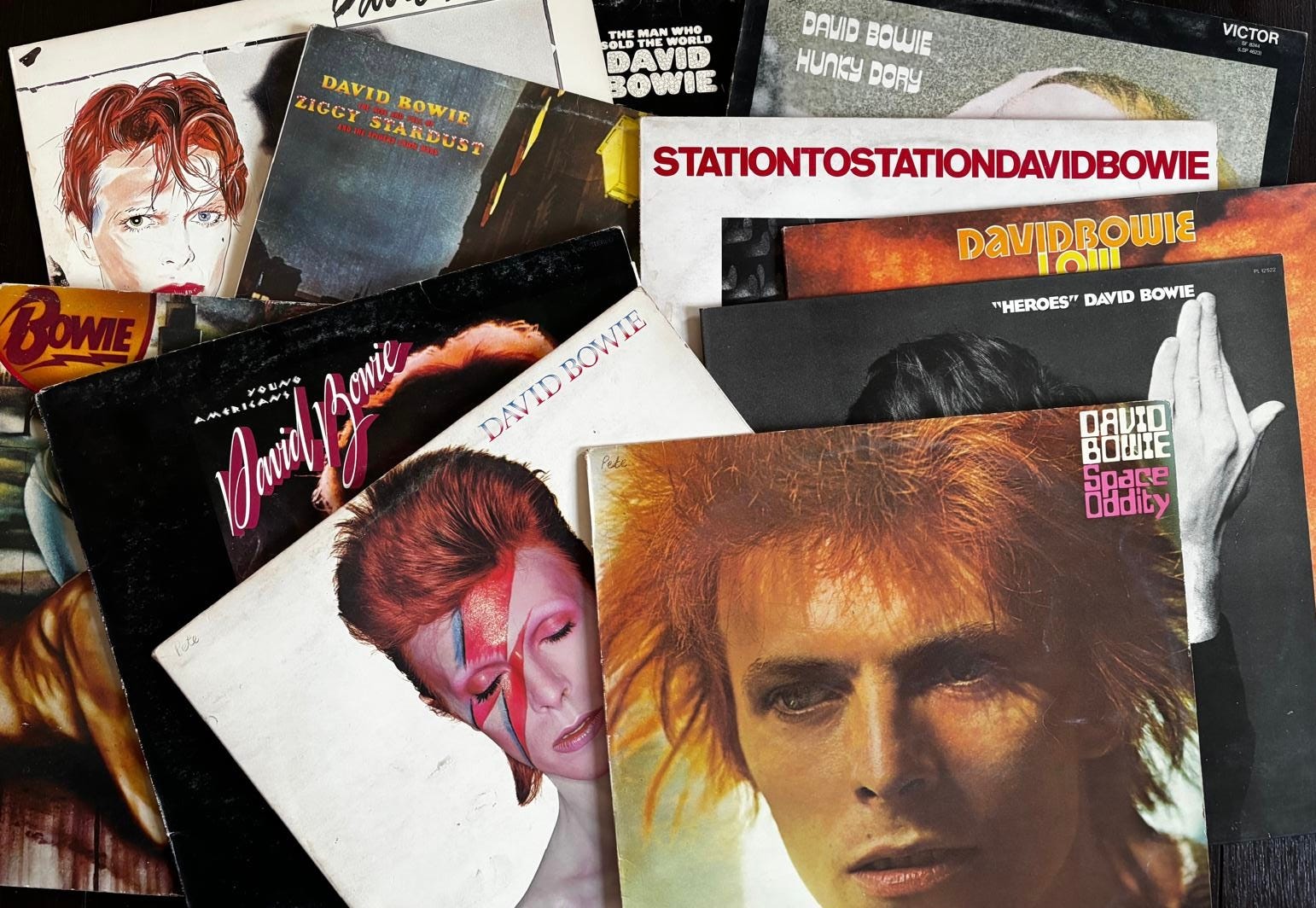
From when I was 12-years-old, David Bowie brought out 13 albums in 11 years
I didn’t know David Bowie. I never even met him.
Though he surely knew me.
From the age of twelve until I was twenty-three, Bowie contrived thirteen albums that were breathtaking in both their variety and impact, in a decade of gale-force creativity.
His music felt like it was injected straight into my veins in my formative years.
Every incarnation of a new alter-ego, every new record, every genre-shift seemed like a big moment.
So yes, it felt like he knew me - and no doubt thousands of other teenagers living ordinary lives in the same kind of drab suburbs Bowie himself came from. He was a splash of colour against the grey, of extravagance against the mundane, and a symbol of people’s freedom to be who they wanted.
Ten years after his death, the music he made, his influence on culture, the way he showed us there are no boundaries to creativity across styles and genres, are all still important me. As he wrote in the song Changes, “strange fascinations fascinate me,” and there’s been nobody in the history of modern music more fascinating than him.
So, I can’t let the tenth anniversary of his death go by without writing something that tries to explain – to myself as much as anyone else – why he is important to me. This isn’t an attempt to write the life and times of David Bowie, but small, personal episodes in which he is the star.
Space Oddity
In the summer of 1969, two men walked on the moon. It was one small step for astronaut Neil Armstrong, and indirectly a giant leap for David Bowie’s career. It also led to a moment of revelation for me.
Bowie was struggling to break through at the time, and his manager Ken Pitt wanted him to write new material. Bowie wrote Space Oddity, partly inspired by going to watch Stanley Kubrick’s film 2001: A Space Odyssey, at a time when the Apollo 11 mission was being planned.
His record label rushed it out as a single just in time for the moon landings. I don’t think I heard it before that moment of history happened, because the BBC initially banned it. The lyrics offered a seemingly bleak narrative about an astronaut being stuck in space, “floating in a tin can.” The BBC lifted the ban once the real astronauts had returned safely to planet earth.
When I did hear Space Oddity, I was totally amazed. It wasn’t like anything I’d ever heard before in pop or rock music. Its construction was episodic and complex. It involved Bowie on guitar, Rick Wakeman on keyboards, the bass player Herbie Flowers and a mini orchestra of violins, violas, cellos, flutes, and an organ.
Space Oddity then became the key track on an album released later that year as David Bowie, but later published as Space Oddity.
My family had a portable record player – one of those with a catch on the lid so you could carry it like a suitcase. Whenever my family stayed at my grandparents’ cottage in the countryside, I would insist on taking it with us.
I would play Space Oddity over and over again, particularly savouring that moment after “check ignition and may God’s love be with you…” when the more powerful section begins with “this is ground control to Major Tom, you’ve really made the grade, and the papers want to know whose shirts you wear..now it’s time to leave the capsule if you dare…” It’s just sublime. I especially liked to listen to it in the pitch dark, of the kind you can only get in the countryside.
Space Oddity is not in my view Bowie’s greatest-ever track, but I would put it in my top ten. It was incredibly innovative at the time, and it’s where it all really started for him. Nevertheless, it was a slow burn until new albums came along in a frenzy of activity as we turned into a new decade.
A Rock and Roll Suicide
Picture the scene. It’s 1973 and the aforementioned record player is on the floor of my bedroom. Next to it there’s now a small pile of Bowie albums – Space Oddity, The Man Who Sold the World, Hunky Dory, The Rise and Fall of Ziggy Stardust and the Spiders from Mars, Aladdin Sane, and the covers album, Pin-Ups.
On the wall, there are various pictures of Bowie – not big posters, but pictures I’ve cut from the music press including the black and white photo of Bowie holding a guitar with one leg kicked high in the air. It was by Brian Ward for the Man Who Sold the World cover. I wish now that I had a much rarer copy of the album with the famous picture of Bowie in a dress.
My leather school satchel was adorned by a decent picture I’d painted of his face from the front cover of Aladdin Sane, complete with Bowie’s red and blue lightning flash.
I also kept a diary – but the only entries I ever made were banal pronouncements like: “Rebel Rebel No.1 in Radio Luxembourg chart.”
After Space Oddity, I bought Hunky Dory (1971) and The Rise and Fall of Ziggy Stardust (1972), though The Man Who Sold the World (1971) was given to me as a present by a girl called Sue. I was astonished and grateful but shamefully didn’t reciprocate.
I had a couple of friends who were also into Bowie, but others who were not. His music had been denounced by my school friend Frank Chamberlain, who liked rock music such as Led Zeppelin and Deep Purple
Trying to persuade him of the genius of Bowie, I would wait until I saw him about to come down my garden path when he called round on the way to get the school bus. Then I would “accidentally” land the record player needle on to a particular section of Width of a Circle on the Man Sold the World album and casually wait for him to say: “This sounds good – who is it?”
Hunky Dory is a great collection of melodic songs. It includes the exceptional Life on Mars, the Bowie classic Changes – who else would start a verse with “I watch the ripples change their size and never leave the stream of warm impermanence” — and Queen Bitch, with its raunchy Velvet Underground vibe.
Bowie’s track Song for Bob Dylan was where I first learned that Bob Dylan’s name was really Robert Zimmerman. “Now hear this Robert Zimmerman, I’m writing just for you. About a strange young man called Dylan, with a voice like sand and glue.”
The Ziggy Stardust album had an instruction on the back cover – “to be played at maximum volume” – and it most certainly was. Bowie’s appearance on the BBC’s Top of the Pops in July 1972, singing the track Starman had enormous impact, not so much musically, as culturally.
Starman is a brilliant singalong made-for- radio hit, but the band dressed up in colourful Clockwork Orange style jumpsuits, and Bowie, flame-haired, lasciviously draping his arm around guitarist Mick Ronson as he gazed into the camera – and therefore millions of British homes - was electrifying.
The young generation was inspired – “let all the children boogie…” The older generation outraged - or at least a bit shocked – and Bowie’s career given rocket boosters as a result.
The blast of rock and roll provided by Ziggy elevated my sense of anticipation for the release of the next album, Aladdin Sane. I rushed to buy it from the Woolworths store (not very rock and roll) in Warwick, England.
There was a lot to take in even before I slid the record on to a turntable.
The main picture on the album cover became one of the most famous in the history of rock music – Bowie with orange hair, looking meditative, the blue and red lighting flash across his face and a skin tone that made him look like an alien. It was finished off by what looked like a teardrop on his collar bone. I’ve always thought it looked like something painted by Salvador Dali.
This look was contrived by Brian Duffy and make-up artists Pierre La Roche in a photographic studio in Primrose Hill, London, and the music itself was more daring and experimental than Ziggy.
This was Ziggy’s take on America, and its songwriting informed by his tour of the States. The tracks included Drive-In Saturday, the dramatic Time – I tried to ensure my parents didn’t hear the line “falls wanking to the floor” – and The Jean Genie, as well as extraordinary use of Mike Garson’s avant-garde piano playing.
Garson was a jazz pianist, and the genius of his involvement was that Bowie heard him play, worked out how his improvised style could be used on his title track Aladdin Sane, and then made it happen. As he told Russell Harty in a 1973 interview: “I’m a collector.”
It was on a beach in North Wales in July 1973 that I first saw the awful news.
I was on an annual a trip with the Second Warwick Sea Scouts – we only actually saw the sea once a year - and someone had a copy of a tabloid newspaper. I saw a horrifying headline which I think said “Bowie retires.”
It correctly reported that at the Hammersmith Odeon on the last night of the Ziggy Stardust tour, Bowie had said: “Not only is this the last show of the tour, but the last show we’ll ever do” before launching into Rock and Roll Suicide. He hadn’t even told his band!
I was devastated… and naïve.
After a few days it became clearer that while his alter-ego Ziggy may have been killed off, the career of David Bowie was very much alive.
We should all have seen the clues in the narrative arc of the Ziggy Stardust album and its title track Ziggy Stardust. “When the kids had killed the man, I had to break up the band.” And in the words of the last track on the album, Rock and Roll Suicide. What else did we expect?
Bowie the Commentator and Prophet
On the Dick Cavett talk show in America in 1974, Bowie, acting very shy and constantly twirling a cane he needed only for its fidget value, told his host about his school days: “I wasn’t very academic, but I suppose I was considered arty.”
His lack of academic prowess as a child belies the person he became in later life – definitely intellectual, interested in philosophy, an avid reader of everything from Nietzsche, Homer and Khalil Gibran to Orwell, Capote and William Burroughs, a student of British and Russian history, and a commentator on culture in a way that was ahead of its time.
I’ve written before about how he turned the tables on an interviewer at MTV in 1983, demanding to know why there weren’t more black artists shown on the music channel. Incredibly, he was told that people in towns in the Midwest of the USA might be scared to death by Prince or “other black faces and black music.”
The interviewer said the music choices were to suit all of America and questioned what The Isley Brothers would mean to a 17-year-old. Bowie came back pointedly: “I’ll tell you what the Isley Brothers or Marvin Gaye mean to a black 17-year-old. Surely, he’s part of America as well.”
It was Bowie’s Black Lives Matter moment more than forty years ago.
And his foresight about the internet was spectacular. In 1998 he launched BowieNet online – an interactive site for fans about music and more – at a point seven yers before YouTube was founded. He had understood our digital future.
In an interview on the BBC’s Newsnight in 1999, Bowie said: “The potential of what the internet is going to do to society – for good and bad – is unimaginable. We are on the cusp of something exhilarating and terrifying. It’s going to crush our ideas of what mediums are all about.”
He later told the New York Times that the internet would make music available “like running water or electricity” and predicted the streaming services, which would start years later with Spotify in 2008.
Bowie had seen the future.
After the Young Americans and Station to Station albums, Bowie escaped from the madness of cocaine-fuelled touring in America to spend two “quieter” years in Berlin, where he produced the three albums of the Berlin trilogy – Low, Heroes and Lodger.
The most important song of that period was Heroes, about the Berlin Wall that divided the city. For me as a journalist, I saw the songwriting using a classic journalistic technique, to take a small human example to illustrate a wider point.
In this case it was Bowie witnessing a couple kissing near a guard tower on the wall, and imagining it as two lovers, one from the east and the other from the west taking great risks.
A decade later, he performed a concert in West Berlin where the Berlin Wall was behind the stage as a backdrop. And thousands of East Berliners stood on the other side, applauding and singing along to a track that became an anthem symbolising the struggle to bring down the wall. “I was in tears,” said Bowie later.
And two years after that, in 1989, the wall came down.
He had always painted compelling pictures with the cinematic imagery of his lyrics. Memory of a Free Festival from Space Oddity is a piece of reportage on the way he saw a local music and arts festival in south London.
“The children of the summer’s end gathered in the dampened grass. They played their songs and felt the London sky resting on their hands. It was God’s land. It was ragged and naïve. It was Heaven.”
As a callow youth who liked writing, I was so struck by the lyrics to that song and truly wished that I’d thought of the phrase “ragged and naïve.”
And Five Years from the Ziggy Stardust album is like a scene from a newsreel or a movie with cameos for ordinary individuals. “Pushing through the market square, so many mothers sighing. News had just come over – we had five years left to cry in.”
When I hear Saviour Machine from the Man Who Sold the World, it now makes me think of what some people see as the potential dangers of Artificial Intelligence. In the song, the saviour machine gets bored and cries: “Life is too easy, a plague seems quite feasible now. Or maybe a war, or I may kill you all.”
The Aladdin Sane album was part commentary on life in America, not least Panic in Detroit and Cracked Actor, which was a critique on the decadence and sleaze of Hollywood. “Suck baby, suck, give me your head – before you start professing that you’re knocking me dead.”
Bowie obviously had enormous influence on music and fashion, but he was also an important figure for people who felt like misfits in society, for people who dreamed of something different from what was considered normal, and for the gender curious. He played many parts himself – and inspired others to be who they wanted to be.
Meltdown
In 2002, David Bowie had been appointed curator of the Meltdown Festival at the Royal Festival Hall. It’s a month-long festival of music and arts in which the curator gets to choose all the bands and artists who appear and usually perform themselves on the last night, as Bowie did.
You can imagine the competition for tickets. There are just over 2,500 seats to see a man who sold out huge stadiums worldwide. Unsurprisingly, I couldn’t get a ticket.
The concert was on a Friday night, and I was spending most of my week involved in coverage of the G8 summit in Canada for Sky News, in the days of Bush and Blair and when even Putin was part of the club.
Not giving up on getting into the concert, I flew back overnight from Calgary into London Heathrow, went home for a shower, and then to the venue to stand in a queue in the hope of “returns” of production tickets.
Luckily, I was second in the queue. I read most of a novel during the day and at around 4.30 the first person in the queue got a ticket. At 6pm, so did I! It was a ticket in the 5th row from the front. It cost £25.00 for something I would have paid very much more, just to be there.
The idea of the event was that the first half would be a deep dive into Bowie’s Low album and the second half mostly from Heathen, plus some other material.
The stage was in darkness, and the anticipation made me bite my own knuckles.
Suddenly there was a spotlight picking out David Bowie at a keyboard, opening the set with Weeping Wall, followed by Warszawa, both thrillingly atmospheric. I found it deeply emotional.
I had seen Bowie several times before, but at Wembley, or places like Milton Keynes Bowl or arenas in London and Birmingham. Never this close. Not anywhere near this close. At one point in the second half, I was leaning on the stage that he was performing on.
To me, the experience was profound. As Bowie had reported in his song Memory of a Free Festival thirty years earlier, it was Heaven.
And it made up for the fact that in 2000 I had gone to see him play the Roseland Ballroom in New York City, only to find a sign on the door written in blue felt pen saying the concert had been cancelled because David Bowie had a sore throat. I hung around there for a while, hardly able to believe it.
Where Are We Now?
In 2004, Bowie had heart problems and was treated for a blocked artery, after which he mostly disappeared and led a quiet life in Manhattan with Iman and their daughter, Lexi, who was born in 2000. The longer time went by, the more it was assumed that there would be no more albums. He’d retired, surely.
In the early hours of Boxing Day 2012, my father died, and I was staying at my parents’ home when it happened. By the time I got back to London I must have been either exhausted or clumsy because I fell down some stairs, made a mess of my elbow, and ended up in hospital.
While I was there, on January 8th, 2013, (Bowie’s birthday), a video appeared online of a new Bowie single complete with a strange but compelling video – Where Are We Now? – which has Bowie looking back at his time in Berlin. There was also news of a forthcoming album to be called The Next Day.
“Where Are We Now?” is a simple and sad song. It poignantly contemplates the past in a mood of melancholic nostalgia as he wanders through the landmarks and ghosts of his past. Bowie refers to himself as “a man lost in time near KaDeWe*…just walking the dead.”
And I lay in my hospital bed crying my eyes out. Of course, the tears were entirely about the loss of my wonderful Dad. But the emotional response was prompted by Bowie and the very nature of a song about the past and about ageing.
I think the outro to the song perhaps means it’s also about love. “As long as there’s sun, as long as there’s rain….as long as there’s me, as long as there’s you.”
Blackstar
“Something happened on the day he died. His spirit moved a metre and stepped aside. Somebody else took his place and bravely cried ‘I’m a Blackstar.”
Blackstar was David Bowie’s final album released on his 69th birthday two days before his death from liver cancer. I spent the first couple of days trying to research what “the villa of Ormen” could be, what the Blackstar could be, and what we were supposed to gather from the “skull designs upon my (his) shoes.”
The album was a masterwork. And again, a departure, using Donny McCaslin and his fellow New York jazz musicians to create a sound that seemed to add to the mystery we were supposed to untangle.
I remember noting that it was the first David Bowie album that hadn’t depicted his face in some way on the cover. But I didn’t read anything into that.
It was just before 0700, UK time, on January 10th, and I was halfway down the stairs at home in London on my way to work at Sky News. My wife Cornelia shouted, “David Bowie died!”
For two seconds, I couldn’t take it in. It can’t be right, and I’ve had no alert on my phone. In fact, her Sky News alert had gone off about ten seconds before mine, and then I saw it on my own device from my own news organisation. It was true.
I suggested to the news desk that they send Katie Spencer, Sky’s Arts and Entertainment Correspondent, to Brixton where there is a big piece of art depicting Bowie on a wall, and where people might gather, which is exactly what happened. And I spent the day entirely in journalist mode, mostly as the story consultant, because people in the newsroom knew that I knew a lot about Bowie and his significance.
It was only on getting back to the top of the same stairs at home where I first heard the news that I suddenly got emotional about it.
David Bowie was no longer in the world.
The mystery in the songs and videos was sadly solved. Bowie had kept secret the fact that he was dying from all but a very few people.
“Look up here, I’m in Heaven - I’ve got scars that can’t be seen,” he sings on the track Lazarus. The video accompanying Blackstar showed a seemingly lifeless astronaut in something that looked like a moonscape with an eclipse in the background.
Major Tom had returned to space for ever.
As Bowie had written almost half a century before: “Ground control to Major Tom, your circuit’s dead, there’s something wrong…”
Blackstar was Bowie’s exposition of his own death without having to talk about it, other than within his art. But it was also a parting gift to the world by one of the greatest content creators of all time.
It was such a sweet thing that my mother, who knows very little about rock music, phoned me up to say that she was sorry that David Bowie had died because she knew how much he meant, and still means, to me.
Ten years later, I still miss him, I still listen to him – though not obsessively. I still read about him, I turn up the radio if a Bowie track is played, I love to hear his speaking voice, especially the more mature Bowie who had so many intelligent things to say to the world.
My biggest feeling about him is pure admiration for his limitless creativity and drive. On the chaotic Diamond Dogs tour of America, Bowie called his long-time producer and collaborator Tony Visconti in the UK and said he wanted to do a soul album. Visconti understandably said, sure – he could discuss it when the US tour was over. But no, Bowie wanted to do it now.
So, the Young Americans album, with its blue-eyed soul sound, was written and recorded in Philadelphia while Bowie was in the middle of his tour, and the track Fame became his first number one in the US charts. It’s just one example of his limitless talent and force of will.
Every now and then I watch the video of Bowie and Annie Lennox rehearsing Under Pressure backstage for the Freddie Mercury tribute concert. Watch it if you haven’t already.
I also return from time to time to a video from the A&E Network in America of its Live by Request show on which Bowie appeared in 2002. It was a live music performance where the setlist was determined by callers phoning in to talk directly to Bowie to tell him what track they wanted to hear next.
This is not shy, cocaine-consuming Bowie from the 1970s talk shows. This is happy, confident Bowie, performing at the top of his game, having fun with the punters. Watch it on YouTube. It’s a joy to behold.
At one point he’s asking Michael from Minneapolis what he wants him to perform next: “Preferably one of mine,” says Bowie, flashing his grin. “No Neil Diamond.”
*KaDeWe is a department store in Berlin

Bowie has an archive at the V&A Storehouse in East London containing 90,000 items.
Just a perfect summary- brilliant writing
A wonderful and moving account of a man who was undeniably a giant of world arts, and in his private manners & outlook a great English gentleman, as many many accounts testify. There’s a sadness in your elegy not only about him but about a lost shared culture, when each new LP was a moment that somehow changed life (as was also the case with the Beatles), and when an appearance on Top of the Pops, in an era even before VHS recording, could be so epochal that it’s remembered 50 years on. He was a prophet of the internet but he might not have realised the impact; that we all now live in a constant post-modern present, in which time has been almost dissolved. We should treasure the era when youngsters from drab uk suburbs & housing estates were able to change world culture.