
JOURNALISM AT A CROSSROADS
TRUTH IS THE ROUTE TO REBUILD TRUST

Journalists used to have unique superpowers.
We had abilities that nobody else possessed or could hope to.
In the late 1970s, I used to write news for national newspapers. The stories would be printed and read by mere mortals at their breakfast tables, or on the train to work.
Nobody else could do that.
When I would go out with a tape recorder in the early 1980s to interview miners on a picket line, or striking car workers, or parents concerned about a school closure, I could go back to my radio station, write a script, play the interviews and talk about my story on air.
Nobody else could do anything like that, other than my colleagues in the newsroom.
Later in the same decade, I could go out with a camera crew and film pictures and interviews that would be broadcast on BBC television. I could communicate news and information to thousands of people.
Only we journalists had that superpower.
And then came the internet, the 24-hour news cycle, the digital explosion, smartphones, social media, YouTube, and the ability for everyone to share, to upload video, have their say, to report things they had witnessed, to tell the truth, or to tell lies.
The internet has democratised news, and the world of journalism is now more exciting, more diverse, and more dynamic in so many ways. But complexity doesn’t come without complications.
I thought about this profound change recently during a week of trying to explain the myriad current issues in journalism to a wonderful group of teachers from the United States, who had signed up to the media literacy course I was running.
One of the biggest themes of the week was about the public’s trust in news media, which has declined significantly in the last decade.
In the UK, according to the respected Reuters Digital Report, only 35% of people say that they “trust most of the news most of the time”. In the USA, that figure is only 30%.
And one of the many reasons for that decline in trust must surely be that objective, quality journalism is fighting to be heard – and sometimes believed – in today’s multifarious media world.
In the first part of my career, the only people who had the access or the technological means to communicate news to the masses were the journalists.
And you could only be a journalist if you had a job at a newspaper, a news agency, a radio station, or a TV news operation.
The News was handed down to us on the radio, in a newspaper through our letterbox, or on television at 6pm or 10pm.
The coverage consisted of a set of largely agreed facts, about which people might have different opinions, and about which there would be debate.
These days, it’s often the case that people can’t even agree on the facts, and social media has stirred the debate into a toxic brew.
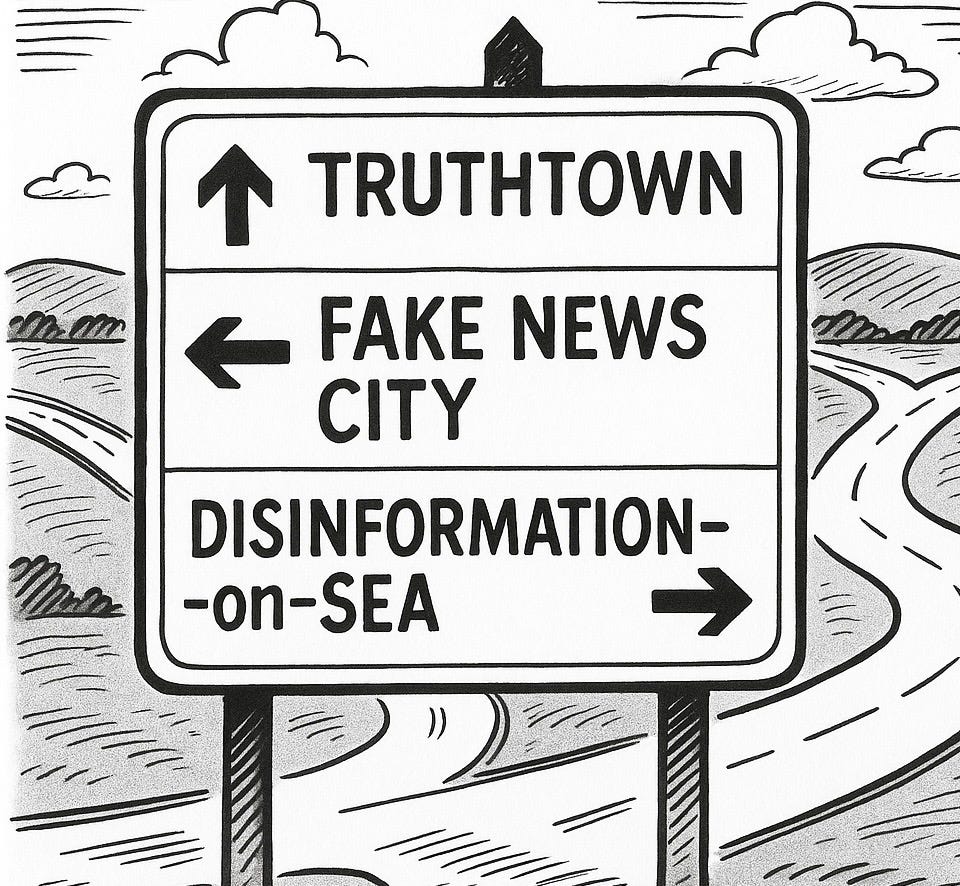
The once sedate and steady stream of news and information has become a swollen, raging river of infinite content in which disinformation boils in the current along with straightforward, truthful reporting.
As a consumer, if you often come across content that is wrong or misleading, you start to wonder what you can trust.
And the journalists have lost their unique superpower — because everyone now has the means to communicate to the masses.
So why have so many people become less trusting of the so-called mainstream media? The volcanic explosion of content is just one reason. Here are some of the others:
POLITICAL POLARISATION
Polarisation in democratic societies is the enemy of factual, objective news reporting. Because even if you report a story accurately, there may be a huge section of society who just don’t want to hear it that way. It does not fit in with their world view…so it must be lies.
People are being driven away from a consensual narrative towards extremes. And that leads to some people refusing to believe news stories which are 100% accurate.
2016
The increasing polarisation of our age has been amplified by populism. And to me, the year 2016 was a pivotal moment in modern history.
This was the year of the Brexit referendum in the UK in which both sides made claims which were theoretical and could not be tested until after the decision to stay in the European Union or leave.
For example, the assertion by Boris Johnson that, by leaving, the UK could stop sending £350 million a week to the EU and put it instead into the National Health Service. Do you think that turned out to be true? Of course not.
2016 was also the year that Donald Trump became President the first-time. And here was another populist politician whose utterances were not always true.
World leaders not telling the truth, provably and consistently, is not a great place for journalism to be, because calling it out and not calling it out both have negative effects.
SOCIAL MEDIA
Social media has played big part in the polarisation of politics and public discourse, despite Nick Clegg, former President for Global Affairs at Meta, claiming otherwise.
It drives people with extreme views to become more extreme.
And without Twitter, as it was then called, Donald Trump would not have been President the first-time round, as he has said himself.
Social media also helped to drive the storming of the Capitol after Trump lost the next election, and it played a big part in the divisive Brexit debate in the UK.
FAKE NEWS
Social media is super-highway for fake news.
The increase in disinformation is a problem for honest news media organisations because people who believe the material that is wrong, may not therefore believe the material that is right.
Misinformation and disinformation spreads doubt about everything.
Soon after the Americans bombed nuclear sites in Iran recently, there were pictures online of crowds surrounding crashed U.S. planes, supposedly shot down. Completely fake and, this time, easy to spot. The internet is full of fakery every day, and the deep fakes will only get more sophisticated.
NEWS v OPINION
The proportion of comment and opinion versus straightforward news has gone up significantly in both the UK and the USA over the decades.
Deployment on news coverage, particularly abroad, can be very expensive.
Opinion is cheap.
And outrageous opinion can get you more clicks.
58% of people say that they have trouble differentiating between what is news and what is comment. If you pick up an actual newspaper or scroll the newspaper view online, there should be no problem because comment pages are clearly marked.
But I can understand why people may say this. The atomisation of media means that people often read articles in isolation because they’ve been posted to social media. If you just read a hard-hitting comment piece, you’re not exposed to alternative arguments so easily.
Newspapers with an axe to grind are perfectly capable of getting their barbs into politicians they don’t like within what are ostensibly news stories.
As I write this, I have just seen a notification from the Telegraph that is headlined: “Starmer vs Macron: Who has been the biggest failure?”
Is this news, or opinion? I guess it’s analysis. But you can be sure that the Telegraph wants you to believe they are both failing politicians.
BIAS, OWNERSHIP + INFLUENCE.
There has been quite a bit of research suggesting that ownership of media organisations creates a built-in bias, with stories shaped by the views of the proprietors.
For example, the Daily Telegraph in the UK is a strongly conservative newspaper which has been owned over the years by people like Conrad Black and the Barclay Brothers, and they just don’t like having a Labour government — in the same way that The Guardian newspaper never likes having a Conservative one.
In America, there are examples of owners trying to prevent perceptions of ownership interference. Jeff Bezos, who owns the Washington Post, stopped the newspaper’s endorsement of Kamala Harris at the last election because he said endorsements undermine the idea of the Post’s independence.
And yet he’s ordered a change to the comment sections so that there is more promotion of personal liberties and free markets. To me, that sounds like a built-in bias.
It was the Washington Post that exposed the Watergate scandal and caused the resignation of Nixon at a time when I was first thinking of becoming a journalist. And that was exactly the time when trust in the news media in America was sky high.
So perhaps news organisations in the USA could have done themselves a favour by digging deeper than they did into the conspiracy of silence around Joe Biden’s fitness to be President.
CHURNALISM
Hard-pressed local newspapers resort to quite a lot of churnalism — easy stories written from press releases, the police press office website, or endless follow-ups to the same ongoing story in which only two paragraphs are new.
I sympathise. This part of the industry has suffered a 70% reduction in advertising revenue in a decade. Fewer journalists can mean more click-bait and less original journalism.
Today I have seen this “news story” on a local website: “Marks and Spencers shoppers rave about comfortable M+S sandals which cost just £15!” It’s really advertising.
What annoys me most on news sites is the headline cleverly written to suggest something interesting and surprising, but once you click you realise it isn’t interesting at all.
SUBSCRIPTION
There are some positive consequences of the growth over the last decade in subscription, because the paywalls often lead to extra investment in journalism, as at the New York Times, which has 1,700 journalists.
But there’s also a question about whether you are paying an entrance fee to your own echo chamber. It’s good to read from a variety of sources.
GLOBALISATION
Political and business leaders - the elites of liberal democratic societies – saw globalisation as a positive force. Prosperity for all!
But millions of people in Britain, Europe and America didn’t see or feel the benefits, so it meant journalism was sometimes telling an economic story which voters did not recognise.
After the pandemic, news organisations in the UK got very much better at reporting on consumer issues and the cost-of-living crisis.
In its recent digital trends survey, the Reuters Institute tried to address the issue of trust with news consumers.
The four themes which came up the most with audiences were: a desire for impartiality, where journalists “don’t push their own agenda;” accuracy and truth-telling and checking facts; transparency over sources, showing evidence to go with claims, disclosure about conflicts of interest; and better reporting (sounds a bit vague) where consumers asked for journalists to spend their time investigating powerful people and providing depth rather than chasing algorithms for clicks.
Most journalists I know would say that this is is what mostly happens already. Though in local news, the desire for in-depth journalism is harder to fulfil than it used to be. The better model for long-form local journalism may well be that pioneered by Joshi Hermann at Mill Media.
Five years ago, he experimented to see whether people would be prepared to pay for high quality local news. It started with an email to just 24 people.
The project is still going, and Mill Media newsletters go out to 170,000 recipients every week. And instead of Joshi writing stories alone in Manchester, there are now 20 full time journalists in six cities in the UK.
The future for journalism is now a kaleidoscope of possibilities and challenges.
Journalists’ work can appear on a range of their company’s own outlets, and another suite of platforms like TikTok, YouTube, Instagram, WhatsApp, X, BlueSky and more.
Newsrooms are embracing AI for positive purposes; data journalism and open-source investigation has revolutionised our ability to underpin stories and verify video; an exciting horde of content creators has flooded the zone in factual, explanatory storytelling, and newsrooms are investing even more heavily in vertical video techniques.
But however journalism develops, the practitioners need to be true to the idea that it’s a public service in which reporting needs to be accurate, factual, and objective – not something that’s spun for the delectation of whoever is in your tribe.
The ability to dig out the truth from the chaos of our current world really is an essential superpower.
Excellent and comprehensive account of the challenges confronting our industry.
Once upon a time, “journalist” was a superpower—now it’s just anyone with Wi-Fi and a grudge.
There’s a real art to nostalgia, especially when you can remember a time when facts came in single servings instead of an all-you-can-eat buffet. Yet, the piece nails what’s been lost: the thrill of earning trust, not just grabbing attention.
📌 Maybe the true “exclusive” now is integrity.
⬖ Filed under endangered virtues via Frequency of Reason: bit.ly/4jTVv69